
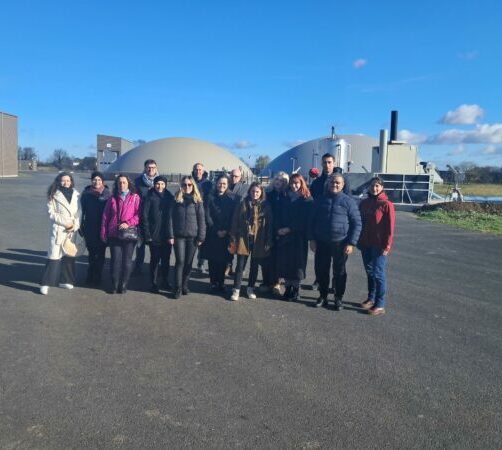
From the 16th of November 2025 to the 21st of November 2025, participants from France, Portugal, Bulgaria and Turkey participated in a learning trip organized by the operational team of the SUSRUD project.
The 16 participants visited several biogas digester units illustrating the challenges and opportunity of this technology in local contexts. The speakers highligthed the many challenges of such endeavor, and the added value they took our of these projects. The participants also visited a woodchip boiler in Creuse, one of the local projects that contribute to the change of fossil fuel boilers to biomass energy boilers by relying on the local farming hedges. The community of Est Creuse Dévelopment is involved in the project RURAL TRANSITION LABS, cofunded by the Interreg Sudoe programme to address the challenge of local economic value-chain around farming hedges.
The main goal of the trip was to introduce biomass energy projects with a transversal approach anchored in the local contexts. The trip provided technical information and return of experiences to the participants.
Day by day report:
16th of November :
The French team arrived by driving the shuttle bus at Saint-Martin-en-Haut and picked up the other team in the bus station of the next town. The Portuguese team arrived on their own to the hotel.
The first dinner was really important to have an informal presentation and to meet everybody (more or less).
17th of November :
During the morning it was really rainy, the idea was to introduce the territory with a long sightseeing tour. But due to the weather we decided to do a shorter tour and to wait for the afternoon meeting. We went to a bakery to drink coffee and have a discussion about the program for the rest of the week and also to arrange some logistical points.
We ate lunch at “La Fougassette”. Then, we went to the office of the Parc-Eco Habitat where Thomas Robert introduced to us the energy transition strategy of his gathering of collectivities with this main idea of reducing the consumption and growing the production of renewable energy. It was a great point to better understand the visit during the end of the afternoon of the Bio-GNV station in links with the Méthamoly Biogas Digester unit. This afternoon showed us a model where public and private authorities work together thanks to a common energy transition strategy. Finally, for Méthamoly, it’s a unit with injection, where farmers are investors (they also received some subsidies), they produce biogas for vehicles (for an important bus line for example) and they are thinking about the liquefaction of the CO2.
The dinner was a great time to share the feedback of this first day and to discuss what we saw.

18th of November :
We left the hotel quite early to go to Belleville-en-Beaujolais, the main idea was to visit another kind of biogas digester. Indeed, this unit is using sludge from wastewater treatment (domestic), and also manure and organic materials from industrial sites such as paper waste, grapes from the distillery and so on. It’s a project where public and private organizations are really working together because for example the public authority of the territory takes part in the administrative council of the unit. Sylvain Morel answered all our questions during the visit. He is working with the unit, but he is a representative of the public authority.
During the afternoon, we had another presentation of a gathering of municipalities also not too far from Lyon, more or less in the same area. However in this area, they do have an energy transition subject but regarding biomass energy and more specifically biogas digester unit it has been more complicated to deal with the subject for the technician working for the territory. It was quite different from the previous visits. Indeed, Sophie Moncorgé told us that they did a lot of studies regarding biogas digester units, but none of them created a good project. It was really interesting to have a critical point of view about a person who represented the public authorities.

19th of November :
We also left the hotel quite early to have a long trip to the east of Creuse. To have a first approach to this new area, we ate lunch in a restaurant of a rural small town. It was the opportunity to see the difference between the area next to Lyon which is wealthier than the Creuse area. Because in Creuse, the different towns are not influenced by the proximity of Lyon contrary to the Mont du Lyonnais. In addition they don’t have the wealth from the wine production also contrary to the Monts du Lyonnais. As the project is talking about rural areas, it made sense to have a look at hyper rural places where things about energy transition are also moving on. After lunch we went to another biogas digester, the last one. This one is interesting because it’s only a group of farmers that wanted to diversify their incomes and to have the opportunity to valorize their manure and better fertilize their soils. However they have had some obstacles (technical and human). Indeed, the grid was really far from the unit, it cost a lot to reach the grid in another department and some people created a group of opponents against the project. In any case the project has been built. And the mayor of the town is also a farmer and he is taking part in the unit. It helped to discuss with the inhabitants. And the grid has been reached by creating a basic unit to be able to invest on the pipe to reach the grid. Jean-François Aucouturier presented the unit (farmer and president of the unit Méthagenête) and told us at the end that the project is done but it’s not a real success because it’s complex and there are a lot of unknown topics regarding the components of the digestate that is returning to the soil for example.

20th of November :
During the morning we had a workshop about the Framework for a Sustainable Strategic Development. It’s a methodology which is really interesting to think about the sustainability conditions of a project. We did some exercises to introduce and apply the first approach of this methodology by using the example of the biogas digester project (because we saw different projects during the learning trip). It was a great opportunity for the participants to think about all the challenges regarding this kind of project and also to have a general overview that could be interesting for feasibility studies for example. For the students, this methodology could be useful for their research. Of course we did not have the time to see all the methodology, the idea was to attract the interest of each participant to let them search if they are interested in this approach.
Then for the afternoon we had the opportunity to be welcomed by the mayor (Gérard Thommazon) of a rural village in East Creuse. This village was a source of inspiration for all the participants. Indeed, there are 130 inhabitants, the biggest town is Boussac, it’s 10 minutes by car. The municipality has the will to be as autonomous as possible regarding their consumption and production of energy. That is why they started to have a windfarm with 9 turbines, it helped us to have financial incomes. Then they invested in the change of their boiler with the consumption of woodships that are produced with the wood of the municipality, they created a specific building for this boiler and the storage. On the roof of this building they installed solar panels. Finally, to complete this energy mix they are currently building a kindergarten and they will use geothermal energy to heat and cool the building. This town is the perfect example to show that biomass energy is interesting but it’s more powerful when it’s mixed with other energy, it’s also the perfect example to show that rural areas matter and can act for energy transition. It was a good conclusion for the learning trip.


21st of November :
The participants left really early in the morning with a little bit of snow.

