
EARDF co-funded project in Creuse (FR).
The Rural Organic Hazelnut project aims to structure a regional organic hazelnut sector, addressing very concrete challenges: agricultural diversification, preservation of natural resources, and local economic development.
Specifically, the project is organized around two cross-cutting themes and three complementary operational themes, drawn from local practices in eastern Creuse and feedback from the sector.
The two cross-cutting themes are dedicated to a contextual study that will consolidate feedback to better guide the project, and to a project management and knowledge-sharing/dissemination theme.
The first theme concerns the protection of water resources through agricultural practices. It involves supporting the establishment of organic hazelnut orchards by identifying suitable land, thereby creating a complementary relationship between quality agricultural production and water resource preservation.
The second theme focuses on the complementarity between organic hazelnut production and renewable energy production. The aim is to explore, through experimentation, synergies with energy production, particularly via biomass or agrivoltaic systems.
The third focus area concerns economic and territorial development. The project aims to structure agri-industrial markets (as exemplified by Jean Hervé), creating local jobs, and to leverage organic hazelnuts as a tool for tourism promotion, centered around this distinctive product (as exemplified by the Creuse hazelnut cake).
To achieve these ambitions, the project relies on a consortium of complementary partners: agricultural stakeholders, at the forefront of experimenting with and scaling up production; local authorities, which support a sustainable development and local planning approach; and economic stakeholders, essential for structuring markets and ensuring the sector’s viability.
This complementarity allows for a systemic approach to the project, linking production, the environment, and economic development.
Finally, particular attention is paid to stakeholder dynamics: identifying levers for buy-in, anticipating potential obstacles, and building shared governance. This is a key factor in ensuring the project’s long-term success.
In summary, Rural Bio Noisette is a structured, collaborative, and impact-oriented local project, with the ambition of creating a replicable model for other rural areas.
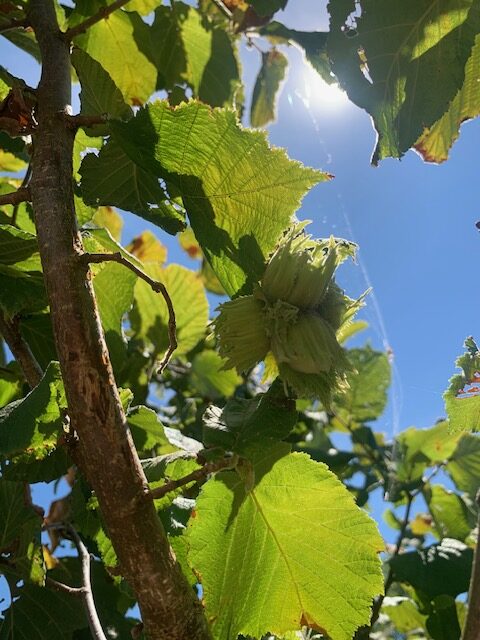
A picture of a green hazelnut fruit. This picture has been made during the launch meeting the 7th of July 2026. This day was split in two parts :
- the first part was the project context presentation in front of institutional stakeholders
- the second part was a visit of an organic hazelnut orchard
This time was absolutely crucial to create the collective dynamic for the entire project duration. The consortium met in-person. Let’s follow the progresses !
